

How To Draw Iris Goddess Of The Rainbow
| Iris | |
|---|---|
| Goddess of the Rainbow, Messenger of the Gods | |
 Guy Head, Iris Conveying the Water of the River Styx to Olympus for the Gods to Swear By (c. 1793) | |
| Abode | Mountain Olympus (peradventure) |
| Symbol | Rainbow, caduceus, pitcher |
| Personal data | |
| Parents | Thaumas and Electra |
| Siblings | Arke, Harpies, Hydaspes |
| Consort | Zephyrus |
| Children | Pothos |
In Greek mythology, Iris (; EYE-riss; Greek: Ἶρις , translit. Íris , lit. "rainbow",[1] Aboriginal Greek: [îːris]) is a girl of the gods Thaumas and Electra, the personification and goddess of the rainbow and messenger of the gods.[two]
Family [edit]

Co-ordinate to Hesiod'southward Theogony, Iris is the daughter of Thaumas and the Oceanid Electra and the sis of the Harpies: Arke and Ocypete.[iii] During the Titanomachy, Iris was the messenger of the Olympian gods while her sister Arke betrayed the Olympians and became the messenger of the gods enemy, Titans. She is the goddess of the rainbow. She likewise serves nectar to the goddesses and gods to drink. Zephyrus, who is the god of the west wind is her consort. Together they had a son named Pothos,[4] or alternatively they were the parents of Eros,[5] the god of love, co-ordinate to sixth century BC Greek lyric poet Alcaeus, though Eros is usually said to be the son of Ares and Aphrodite. Co-ordinate to the Dionysiaca of Nonnus, Iris' blood brother is Hydaspes.[half dozen]
She is too known equally one of the goddesses of the sea and the heaven. Iris links the gods to humanity. She travels with the speed of current of air from one end of the world to the other[seven] and into the depths of the sea and the underworld.

Winged female figure holding a caduceus: Iris (messenger of the gods) or Nike (Victory)
Mythology [edit]
Messenger of the gods [edit]
In some records Iris is a sister to young man messenger goddess Arke (arch), who flew out of the company of Olympian gods to join the Titans equally their messenger goddess during the Titanomachy, making the ii sisters enemy messenger goddesses. Iris was said to take golden wings, whereas Arke had iridescent ones.[ citation needed ] She is also said to travel on the rainbow while conveying letters from the gods to mortals. During the Titan State of war, Zeus tore Arke'south iridescent wings from her and gave them every bit a gift to the Nereid Thetis at her wedding, who in turn gave them to her son, Achilles, who wore them on his anxiety.[8] Achilles was sometimes known equally podarkes (feet like [the wings of] Arke). Podarces was too the original name of Priam, king of Troy.
Following her daughter Persephone's abduction by Hades, the goddess of agriculture Demeter withdrew to her temple in Eleusis and made the globe barren, causing a corking dearth which killed off mortals, and as a result sacrifices to the gods ceased. Zeus then sent Iris to Demeter, calling her to bring together the other gods and lift her expletive; but as her daughter was not returned, Demeter was not persuaded.[9]
Co-ordinate to the lost epic Cypria by Stasinus, it was Iris who informed Menelaus, who had sailed off to Crete, of what had happened back in Sparta while he was gone, namely his wife Helen's elopement with the Trojan Prince Paris besides equally the decease of Helen'south brother Castor.[10]
Iris is frequently mentioned as a divine messenger in The Iliad, which is attributed to Homer. She does not, however, appear in The Odyssey, where her role is instead filled by Hermes. Like Hermes, Iris carries a caduceus or winged staff. By command of Zeus, the rex of the gods, she carries a ewer of h2o from the River Styx, with which she puts to sleep all who perjure themselves. In Book XXIII, she delivers Achilles'southward prayer to Boreas and Zephyrus to light the funeral pyre of Patroclus.[11]
Iris too appears several times in Virgil'south Aeneid, usually equally an amanuensis of Juno. In Volume 4, Juno dispatches her to pluck a lock of pilus from the head of Queen Dido, that she may die and enter Hades.[12] In book 5, Iris, having taken on the class of a Trojan woman, stirs upwardly the other Trojan mothers to prepare burn to iv of Aeneas' ships in order to foreclose them from leaving Sicily.[13]
According to the Roman poet Ovid, after Romulus was deified as the god Quirinus, his wife Hersilia pleaded with the gods to permit her become immortal besides so that she could be with her hubby over again. Juno heard her plea and sent Iris downward to her. With a single finger, Iris touched Hersilia and transformed her into an immortal goddess. Hersilia flew to Olympus, where she became one of the Horae and was permitted to alive with her hubby forevermore.[fourteen] [15]
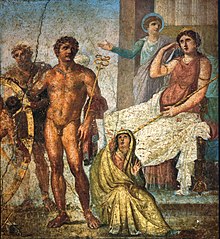
Iris stands behind the seated Juno (correct) in a Pompeii fresco
Other myths [edit]
Co-ordinate to the "Homeric Hymn to Apollo", when Leto was in labor prior to giving birth to her twin children Apollo and Artemis, all the goddesses were in attendance except for two, Hera and Eileithyia, the goddess of childbirth. On the ninth day of her labor, Leto told Iris to bribe Ilithyia and ask for her assist in giving nascence to her children, without allowing Hera to find out.[16] According to Callimachus, Iris along with Ares ordered, on Hera'southward orders, all cities and other places to shun the pregnant Leto and deny her shelter where she could bring along her twins.[17]
According to Apollonius Rhodius, Iris turned back the Argonauts Zetes and Calais, who had pursued the Harpies to the Strophades ("Islands of Turning"). The brothers had driven off the monsters from their torment of the prophet Phineus, but did non kill them upon the asking of Iris, who promised that Phineus would not exist bothered past the Harpies again.
In a lesser known narrative, Iris once came close to being raped by the satyrs afterward she attempted to disrupt their worship of Dionysus, perchance at the behest of Hera. About 15 blackness-and-red-figure vase paintings dating from the fifth century BC depict said satyrs either menancingly advancing toward or getting hold of her when she tries to interfere with the sacrifice.[18]
In Euripides' play Herakles, Iris appears alongside Lyssa, blasphemous Heracles with the fit of madness in which he kills his 3 sons and his wife Megara.[19]
Worship [edit]
Cult [edit]

Weber-Laborde head Louvre, possibly the head of Iris.

There are no known temples or sanctuaries to Iris. While she is frequently depicted on vases and in bas-reliefs, few statues are known to take been fabricated of Iris during antiquity. She was however depicted in sculpture on the west pediment of Parthenon in Athens.
Iris does appear to take been the object of at least some minor worship, simply the only trace preserved of her cult is the note by Athenaeus in Scholars at Dinner that the people of Delos sacrificed to Iris, offering her cheesecakes called basyniae, a blazon of block of wheat-flour, suet and beloved, boiled up together.[21]
Epithets [edit]
Iris had numerous poetic titles and epithets, including chrysopteros ( χρυσόπτερος "golden winged"), podas ōkea ( πόδας ὠκέα "swift footed") or podēnemos ōkea ( ποδήνεμος ὠκέα "wind-swift footed"), roscida ("dewy", Latin), and Thaumantias ( Θαυμαντιάς "Daughter of Thaumas, Wondrous One"), aellopus ( ἀελλόπους "storm-footed, storm-swift).[22] She as well watered the clouds with her pitcher, obtaining the water from the ocean.
Representation [edit]
Iris is represented either as a rainbow or as a beautiful young maiden with wings on her shoulders. As a goddess, Iris is associated with communication, messages, the rainbow, and new endeavors. This personification of a rainbow was in one case described as being a link to the heavens and earth.[23]
In some texts she is depicted wearing a coat of many colors. With this coat she actually creates the rainbows she rides to get from place to identify. Iris' wings were said to be so beautiful that she could even low-cal up a nighttime cavern, a trait observable from the story of her visit to Somnus in guild to relay a message to Alcyone.[24]
While Iris was principally associated with communication and messages, she was also believed to assistance in the fulfillment of humans' prayers, either by fulfilling them herself or by bringing them to the attention of other deities.[25]
Gallery [edit]
-

The Iris: an Illuminated Souvenir (1852)
-

Grèce - Série courante de 1913-24 Type "Iris" - litho - Yvert 198B
-

Iris (tiré d'united nations vase antique). Illustration de "Histoires des météores" (1870)
-

-

Notes [edit]
- ^ Etymology of ἶρις in Bailly, Anatole (1935) Le K Bailly: Dictionnaire grec-français, Paris: Hachette.
- ^ Smith, s.5. Iris.
- ^ Hesiod, Theogony 265; cf. Apollodorus, 1.ii.6.
- ^ Nonnus, Dionysiaca 47.340
- ^ Alcaeus frag 149
- ^ Nonnus, Dionysiaca 26.355–365
- ^ The Iliad, Volume II, "And now Iris, armada as the wind, was sent by Jove to tell the bad news amongst the Trojans."
- ^ Ptolemy Hephaestion, New History Book 6; epitomized in Photius' Bibliotheca 190
- ^ Homeric Hymns 2.314–325
- ^ Proclus' summary of Stasinus' Cypria.
- ^ Mackie, Christopher John (2011). "The Homer Encyclopedia". Credo Reference.
- ^ Virgil, Aeneid 4.696
- ^ Virgil, Aeneid 5.606
- ^ Ovid, Metamorphoses 14.829–851
- ^ McLeish, Kenneth. "Bloomsbury Dictionary of Myth". Credo Reference.
- ^ Grant, Michael (2002). "Who's Who in Classical Mythology, Routledge". Credo Reference.
- ^ Callimachus, Hymn to Delos 67–69
- ^ Donald Sells, Parody, Politics and the Populace in Greek Old One-act pg. 112
- ^ Euripides, Heracles 822
- ^ British museum 1816,0610.96.
- ^ Athenaeus, Scholars at Dinner 14.53; comp. Müller, Aegin. p. 170.
- ^ Homer uses the culling course aellopos ( ἀελλόπος ): Iliad viii. 409.
- ^ Seton-Williams, One thousand.V. (2000). Greek Legends and Stories. Rubicon Printing. pp. 75–76.
- ^ Bulfinch, Thomas (1913). Bulfinch's Mythology: the Age of Fable, the Age of Chivalry, Legends of Charlemagne: Complete in 1 Book. Thomas Y. Crowell Co.
- ^ Seton-Williams, M.V. (2000). Greek Legends and Stories. Rubicon Press. p. 9.
References [edit]
Ancient [edit]
- Homer, The Iliad with an English Translation past A.T. Murray, PhD in ii volumes. Cambridge, MA., Harvard University Press; London, William Heinemann, Ltd. 1924. Online version at the Perseus Digital Library.
- Hesiod, Theogony, in The Homeric Hymns and Homerica with an English Translation by Hugh G. Evelyn-White, Cambridge, MA., Harvard Academy Press; London, William Heinemann Ltd. 1914. Online version at the Perseus Digital Library.
- Evelyn-White, Hugh, The Homeric Hymns and Homerica with an English Translation past Hugh G. Evelyn-White. Homeric Hymns. Cambridge, Massachusetts, Harvard University Press; London, William Heinemann Ltd. 1914.
- Euripides, The Complete Greek Drama', edited by Whitney J. Oates and Eugene O'Neill, Jr. in two volumes. 2. The Phoenissae, translated by Due east. P. Coleridge. New York. Random Business firm. 1938.
- Apollonius Rhodius, Argonautica translated by Robert Cooper Seaton (1853–1915), R. C. Loeb Classical Library Volume 001. London, William Heinemann Ltd, 1912. Online version at the Topos Text Project.
- Callimachus. Hymns, translated by Alexander William Mair (1875–1928). London: William Heinemann; New York: Grand.P. Putnam's Sons. 1921. Online version at the Topos Text Project.
- Apollodorus, Apollodorus, The Library, with an English language Translation by Sir James George Frazer, F.B.A., F.R.Due south. in two Volumes. Cambridge, MA, Harvard University Printing; London, William Heinemann Ltd. 1921. Online version at the Perseus Digital Library.
- Vergil, Aeneid. Theodore C. Williams. trans. Boston. Houghton Mifflin Co. 1910. Online version at the Perseus Digital Library.
- Ovid. Metamorphoses, Book I: Books ane–8. Translated by Frank Justus Miller. Revised by 1000. P. Goold. Loeb Classical Library No. 42. Cambridge, Massachusetts: Harvard University Printing, 1977, first published 1916. ISBN 978-0-674-99046-3. Online version at Harvard University Printing.
Modern [edit]
- Grimal, Pierre (1996). "Iris". The Dictionary of Classical Mythology. ISBN 978-0-631-20102-1. pp. 237–238.
- Peyré, Yves (2009). "Iris". A Dictionary of Shakespeare'southward Classical Mythology, ed. Yves Peyré.
- Smith, William (1873). "Iris". Dictionary of Greek and Roman Biography and Mythology. London.
External links [edit]
- IRIS from The Theoi Project
- IRIS from Greek Mythology Link
- Hesiod, the Homeric Hymns, and Homerica by Hesiod (English translation at Project Gutenberg)
- The Iliad by Homer (English translation at Project Gutenberg)
- The Argonautica, by c. tertiary century BC Apollonius Rhodius (English translation at Project Gutenberg)

Source: https://en.wikipedia.org/wiki/Iris_%28mythology%29
Posted by: osbornbelive1950.blogspot.com
0 Response to "How To Draw Iris Goddess Of The Rainbow"
Post a Comment